


Plant Surveys, Insect Studies, and a New Team Member

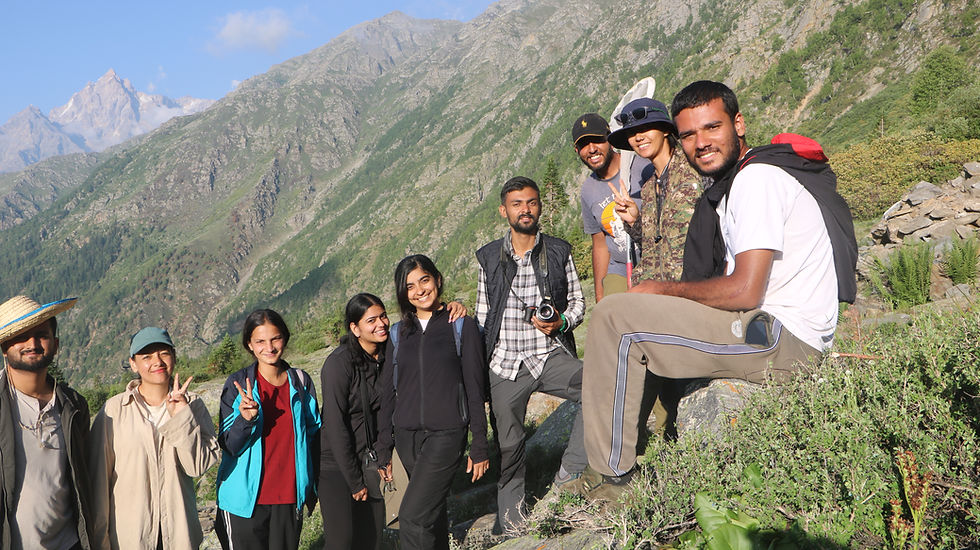
Week Four marked a vibrant chapter in the ongoing journey of the Saryan Vigyan Foundation's summer internship. The team not only deepened their field research but also welcomed a new member: Shivam, who joined the programme to study plant-pollinator interactions. With this addition, the group expanded both in numbers and perspective, bringing fresh energy to the field sites.
This week marked a significant step forward in both learning and field readiness for our interns. As their confidence in core research methods grew, they applied new skills in plant identification, insect observation, herbarium preparation, and transect sampling. Guided by the expertise of taxonomist Ashutosh Sharma, they refined their techniques and deepened their understanding of biodiversity monitoring in mountain ecosystems.
The team visited Mebar village, Ereskotang, and Harang, where they encountered rain-soaked meadows, recovering fallow fields, and forest patches rich in post-monsoon life.
The interns visited Saryan Vatika, Saryan Vigyan Foundation’s primary ecological site for research and restoration. This high-altitude botanical garden is home to a rich variety of native Himalayan species and serves as a space to implement studies, observe plant succession, and grow threatened flora. For the interns, it offered a focused environment to apply their skills in a living landscape shaped by both science and conservation.

Documenting a Comeback: Plant Recolonisation in Abandoned Fields
Interns Anjali and Poonam continued their focused exploration of plant life in landscapes left uncultivated for over a decade. Their research took them through diverse sites, including Mebar, Harang, and Saryan Vatika, where they recorded the gradual return of native vegetation.
“We were counting plant frequency in 13 to 15-year-old fallow fields,” Anjali shared. “Pinus wallichiana is starting to creep back in.” Both interns spent the week learning how to create herbarium specimens, identify species using leaf and stem characteristics, and take scientifically accurate photographs for documentation.
Poonam reflected on her growing familiarity with plant families, noting, “I’ve learned to distinguish between Lamiaceae, Asteraceae, Polygonaceae, and Plantaginaceae. What once seemed indistinct now reveals its structure and identity at a glance.”
Despite frequent rainfall, slippery terrain, and a two-day power cut, the interns remained committed. Raincoats, umbrellas, and power banks kept the fieldwork on track, and their determination was matched by their growing skills in species identification and field documentation.

Insects at Work: Uncovering Patterns of Recolonisation
While the plant surveys unfolded, Shashwat continued his investigation into the recolonisation of insect fauna in abandoned agricultural lands. His transect walks through Saryan Vatika revealed a dynamic insect community including moths, bumblebees, blister beetles, robber flies, and more.
“Bees and butterflies run the day shift, but moths and beetles clock in at twilight,” he observed. His work is beginning to draw connections between the time of day, plant cover, and insect activity, offering a nuanced look into how biodiversity returns to once-cultivated land.
Shivam, the newest addition to the team, joined Shashwat in the field as a research assistant. His project focuses on plant-pollinator interactions, and his early experiences have already shifted his way of seeing the landscape. “I had no idea insects were this organised,” he remarked. “Now I look at flowers and wonder who’s visiting and why.”

Field Skills, Collaboration, and Careful Observation
Beyond data collection, Week Four emphasised the importance of observation, precision, and teamwork. Under Ashutosh Sharma’s mentorship, the interns honed their ability to distinguish species not only by name but by structure, behaviour, and ecological context.
“Ashutosh sir didn’t just teach us identification,” said Poonam. “He taught us how to notice… to really look.”
From learning how to frame a plant for clear photographs to pressing specimens without damaging key features, the interns developed critical field skills. They also supported one another in practical ways: sharing equipment, reviewing notes, and offering encouragement during long days in the field.
Looking Ahead
With species checklists expanding and field data steadily growing, the interns are preparing for the next stage of their projects. The coming week will involve further fieldwork, data entry, and targeted literature review. Some are planning to design small experiments to test emerging ideas.
The internship continues to transform their relationship with the natural world. Each walk through the forest, each pressed leaf, and each quiet moment of observation is helping them grow as thoughtful, skilled, and locally grounded researchers.
Stay tuned for the next update as the learning deepens and new stories begin to take shape in the highland meadows of Kinnaur.


Comments