


From Himalayan Field Sites to National Research Laboratories: 2025 Internship enters its winter phase

As winter arrived in the high valleys of Kinnaur and the field trails became quiet under frost and snow, Poonam Chauhan began a new journey. This season took her beyond the mountain landscapes where she worked in the summers, into laboratories, research institutions, and academic spaces she had only read about before.
After months spent documenting plant diversity and ecological succession in Kinnaur, Poonam started her winter research training feeling both curious and a bit hesitant. It was her first time leaving Himachal Pradesh for academic work, and moving from open landscapes to structured research settings was both exciting and new to her.
Just as she did in her early fieldwork, she started by observing carefully.

Learning the Foundations: Herbarium Science and Botanical Resources
At first, she focused on learning herbarium science, which is the careful process of preserving plant specimens for long-term scientific study. She learned how to mount, stitch, label, catalogue, and store delicate specimens so future researchers can rely on them.
Working with preserved plants showed her that patience is just as important as knowledge in scientific documentation.
Visiting specialised repositories, she saw medicinal plant collections and raw drug samples. This helped her understand how botanical research links forests with pharmacology.
Along with her practical training, Poonam spent time reading botanical books. Key texts like Flora of Simlensis, Flora of Himachal Pradesh, and regional pictorial floras helped her get better at identifying species and understanding how plants are distributed.
She also explored the digital side of modern taxonomy, learning to use global botanical databases that help scientists check classifications and find original species descriptions. Tools like POWO, IPNI, BHL, and eFlora of India showed her the large archival networks behind plant science.

Lessons in Thinking and Practice from the scientific communities
A big moment for Poonam was attending her first academic unconference, an open forum where curiosity guides the discussions instead of strict agendas.
Researchers, students, and practitioners came together to suggest topics, share ideas, and ask questions across different fields. Conversations moved easily between climate science, neuroscience, ecology, and the philosophy of science.
“In science, people connect through ideas,” Poonam reflected. “I learned that listening carefully is just as important as speaking.”
Seeing researchers debate, ask questions, and refine their views helped her see science as a collaborative process shaped by conversation, not just isolated expertise.

Inside India’s Leading Research Institutions
Poonam's winter training gave her access to some of India’s top research institutions, where she saw how laboratory science works alongside ecological fieldwork.
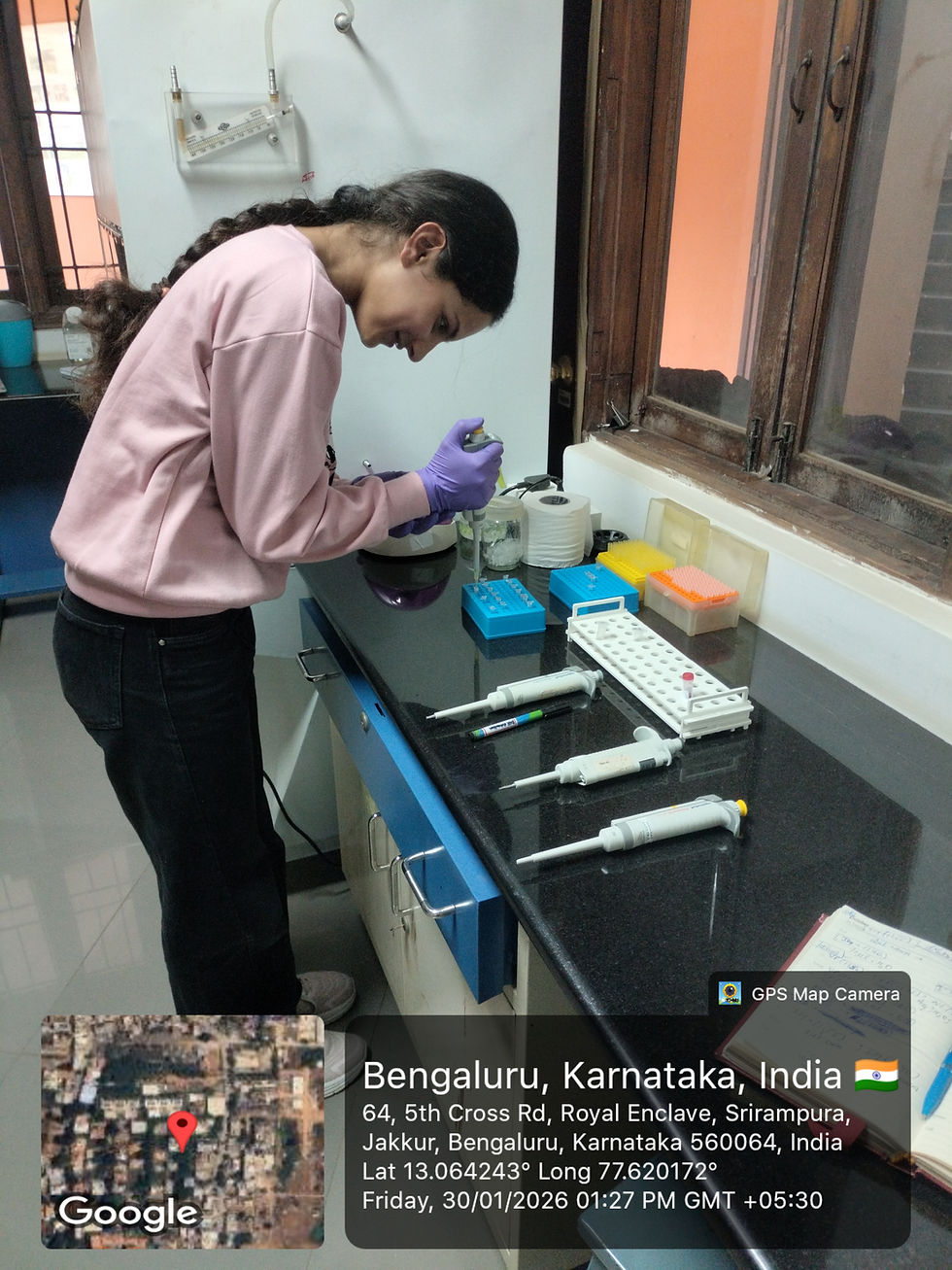
At the Ashoka Trust for Research in Ecology and the Environment (ATREE), she observed molecular biology procedures that revealed life at microscopic scales. DNA extraction techniques, PCR amplification, gel electrophoresis, and buffer preparation demonstrated how genetic tools support conservation science.
Watching genetic material turn into visible bands during lab work helped her appreciate the multifaceted aspects of biodiversity research.
She also learned about lab safety, especially how to handle hazardous substances used in molecular procedures.
At the National Institute of Animal Nutrition and Physiology (NIANP), research took another direction. Here, she observed reproductive physiology studies that strengthen livestock breeding and agricultural sustainability.
She saw work ranging from fertility tests in buffalo to freezing bull semen at −196°C in liquid nitrogen tanks. This showed her how molecular tools help conserve animal genetics over the long term. She learned how scientists study progressive motility, diagnose sub-fertility, and use colour-coded systems to identify breeds.
“These labs showed me how science works across scales,” she reflected. “From genes to ecosystems.”
Over time, Poonam moved to analysing the ecological data she had collected in Kinnaur. She started learning statistical methods and used R software to notice patterns in plant diversity at different stages, which showed how semi-natural grasslands support nearby ecosystems and how abandoned fields slowly recover.
“Working with data changed how I understand landscapes,” she said. “Numbers began telling ecological stories.”
Finishing and submitting her research report was a milestone that boosted her confidence as an independent researcher.

Checklist, Taxonomy, and growing in confidence
Back in her botanical work, Poonam took on the challenging job of making a checklist of endemic plants in Kinnaur. What seemed like a simple list at first soon turned into a lesson in scientific responsibility.
By comparing published records with trusted databases, she found many inconsistencies and taxonomic mistakes. Fixing these made the checklist more reliable for future conservation work.
“Accuracy requires sustained effort and accountability”, she reflects.
Through this work, she started to see taxonomy as an ethical practice that requires patience, careful checking, and attention.
Reading about plant systematics deepened her understanding. Learning about well-known taxonomists like K. N. Gandhi showed her how careful record-keeping and accurate naming help global botanical research.

When she visited a peer’s lab, she learned about fruit fly research. She saw how scientists use ice rather than chemicals to immobilise specimens before examining them under stereo microscopes.
Walking through botanical gardens, she noticed both carefully chosen plants and invasive species. This made her think about conservation decisions, even in protected areas.
Cultural celebrations like Makar Sankranti and Pongal brought warmth to academic life and showed her how traditions and seasonal rhythms are part of research communities.
Talking with mentors also expanded her view of conservation. She learned that research should be guided by purpose, humility, and respect for traditional ecological knowledge, and that young researchers should help connect scientific work with community wisdom.
Looking back, Poonam says her winter internship was a gradual journey from uncertainty to confidence.
At first, she was hesitant, but she grew confident in herbarium work, became skilled at using scientific databases, felt comfortable in research discussions, and learned to move between field data and lab science.
“This journey changed how I see research,” she reflected. “It’s not just about collecting information, but about learning how knowledge is built responsibly.”
Mentor Acknowledgement: Learning Through Guidance
Mentors from different institutions played a big role in shaping her journey.
At the Saryan Vigyan Foundation, Dr. Preeti Saryan’s guidance helped bridge field ecology with scientific inquiry, encouraging young researchers to see data as stories of living landscapes.
Ashutosh Sharma’s mentorship strengthened Poonam’s foundation in taxonomy and plant identification, sharpening her observational skills and introducing her to the rigour of biodiversity documentation.
Mentors and researchers from different institutions patiently guided her in labs and academic spaces, turning unfamiliar places into environments where she could learn and feel confident.
With their support, scientific training became more than just instruction; it became encouragement to grow.
The mountain meadows where she once set up quadrants are now being linked by her to digital databases, herbarium archives, molecular labs, and taxonomic books. The setting changed. The purpose remained.
As this winter chapter ends, her learning continues and will carry forward into future research, conservation, and academic work.


Comments